
The Allahabad High Court has ruled that a woman is entitled to maintenance from her father-in-law even after her husband's death, under specific conditions outlined in the Hindu Adoption and Maintenance Act.

The Supreme Court has directed the central government to provide accurate transcripts of videos related to climate activist Sonam Wangchuk's detention, emphasizing the need for precision in translations, especially with the advent of Artificial Intelligence.

The Supreme Court of India has agreed to examine petitions challenging the constitutional validity of the Digital Personal Data Protection (DPDP) Act, 2023, focusing on concerns about its impact on the Right to Information Act.

The Supreme Court has quashed the FIR against Elvish Yadav, who was arrested for allegedly using snake venom at a rave party in Noida. Yadav expresses relief and questions who will compensate for the harassment he and his family faced.

The Delhi High Court has upheld the acquittal of a man accused of kidnapping and raping a minor, stating that a horoscope and vaccination card are insufficient proof of age for prosecution under the POCSO Act.
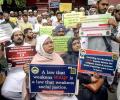
A bench comprising Chief Justice B R Gavai and Justice Augustine George Masih asked senior advocate Kapil Sibal, appearing for those challenging the validity of the law, and Solicitor General Tushar Mehta, representing the Centre, to file their written notes by Monday.

The Election Commission of India is considering launching the final phase of its special intensive revision of voters' lists in the remaining states and Union territories after the assembly elections conclude.
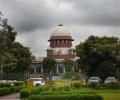
The Supreme Court refused to entertain a PIL seeking to prevent discrimination and violence against citizens from the northeast and other regions, stating that identifying persons on grounds of race, region, sex, and caste would be a regressive step.
The Supreme Court has quashed an FIR and subsequent proceedings against YouTuber Elvish Yadav, who was arrested for allegedly using snake venom at a rave party in Noida. The court cited issues with the applicability of the NDPS Act and the validity of proceedings under the Wildlife (Protection) Act.

The Gauhati High Court has issued a notice to Assam Chief Minister Himanta Biswa Sarma in response to Public Interest Litigations (PILs) accusing him of hate speech, with the court also issuing notices to the Centre, state government, and DGP, and setting a hearing date for April 21.

The Supreme Court has stayed a portion of a Delhi High Court order related to the Lokpal's investigation into Trinamool Congress MP Mahua Moitra in the alleged cash-for-query scam.

The Supreme Court is scheduled to hear a plea by the producer of the Tamil film "Jana Nayagan," starring Vijay, challenging a Madras High Court order that stayed the granting of a censor certificate to the movie. The film's release has been delayed due to certification issues.

The Supreme Court has granted anticipatory bail to folk singer Neha Singh Rathore in connection with a case filed against her over a social media post related to the Pahalgam terror attack. The court's decision comes after Rathore appeared before authorities and cooperated with the investigation.

Mahesh Narayanan's Patriot is a cerebral spy thriller that delves into the weaponisation of digital surveillance against civilians and the targeting of whistleblowers, featuring Mammootty, Mohanlal, and Fahadh Faasil.
The Supreme Court has granted furlough to Vikas Yadav, who is serving a 25-year jail term for the murder of Nitish Katara, allowing him temporary release to spend time with his family during Holi.

The Supreme Court has overturned an Allahabad High Court order, ruling that grabbing of breasts and pulling the pyjama string amount to "attempt to rape".

Gurmeet Ram Rahim Singh, head of Dera Sacha Sauda, has been acquitted by the Punjab and Haryana high court in the 2002 murder case of journalist Ram Chander Chhatrapati, a verdict that is being challenged in the Supreme Court.

Harish Rana, the first person in India to be granted passive euthanasia, has died at AIIMS-Delhi after being in a coma for over 13 years. His case led to a landmark Supreme Court judgment allowing passive euthanasia and sparked discussions about the right to die with dignity in India.
The Supreme Court has rejected a petition seeking to prevent the construction of mosques named after Mughal emperor Babur.

A UK-based doctor, Sangram Patil, is challenging an FIR filed against him in India for alleged objectionable remarks against BJP leaders, claiming it's an attempt to criminalise political speech and dissent.

Banerjee is personally present in court room one along with her lawyers. A gate pass was issued in the chief minister's name on Tuesday.

The Bombay High Court has ruled that the Prevention of Money Laundering Act (PMLA) takes precedence over debt recovery laws like SARFAESI and RDB Acts when it comes to the attachment of proceeds of crime.
The Supreme Court has directed the CBI to submit a status report on the FIRs related to the 2023 Manipur ethnic violence and is considering having the Manipur or Gauhati High Courts monitor the trials.
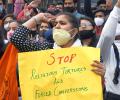
The Supreme Court has sought responses from the Centre and 12 states on a PIL challenging the validity of their anti-conversion laws. The National Council of Churches in India (NCCI) filed the PIL, seeking a stay on the operation of these laws.

The NCERT has issued a public apology and withdrawn a social science textbook for Class 8 after the Supreme Court objected to a chapter on judicial corruption. The court imposed a ban on further publication of the book.

The Kerala High Court has overturned a single judge's order that had put a 15-day hold on the screening of 'The Kerala Story 2-Goes Beyond,' paving the way for the film's release.

'From the email on record placed before me, it is very difficult to conclude that AIFF had persuaded FIFA to send the emails to enable AIFF to seek for modification of the Constitution.
YouTuber Elvish Yadav expresses relief and questions accountability after the Supreme Court quashes the FIR against him in the snake venom case, highlighting the impact of media coverage and the harassment faced by his family.

The family of Dixit Solanki, an Indian seafarer killed in a suspected attack on a merchant vessel off the coast of Oman, has filed a petition in the Bombay High Court seeking the return of his mortal remains.
The Supreme Court has voiced concern over a 'new type of fraud' involving individuals from dominant upper-caste backgrounds in Haryana converting to Buddhism solely to claim minority reservation benefits. The court has sought a report from the chief secretary of Haryana on the issuance of minority certificates.
The Supreme Court is scheduled to hear on Monday Allahabad high court judge Yashwant Varma's plea seeking invalidation of a report by an in-house inquiry panel which found him guilty of misconduct in the cash discovery row.

A court in Madurai, India, has sentenced nine police officers to death for the custodial deaths of a father and son in Sathankulam, Tamil Nadu, in 2020. The victims, P Jayaraj and J Bennix, were killed after being arrested for violating COVID-19 lockdown rules.

The Supreme Court questioned the West Bengal government regarding its objection to the maintainability of the Enforcement Directorate's plea concerning alleged obstruction by Chief Minister Mamata Banerjee during a raid, focusing on the fundamental rights of ED officers.

The Central Bureau of Investigation (CBI) is investigating the Reliance Anil Ambani Group for alleged bank loan frauds totalling 73,000 crore across seven cases. The Supreme Court is monitoring the investigation, which also involves the Enforcement Directorate (ED).
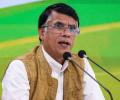
The Gauhati High Court heard arguments for Pawan Khera's anticipatory bail plea, filed after an FIR by the Assam CM's wife alleging multiple passports. Khera's counsel argued he is not a flight risk and his arrest is unnecessary, while the Assam Advocate General opposed the bail.

The Supreme Court has agreed to hear a Public Interest Litigation (PIL) in March seeking action against political parties that promise or distribute 'irrational freebies' before elections. The PIL argues that such practices unduly influence voters and undermine the fairness of the electoral process.
The Jharkhand High Court has directed the Bokaro Superintendent of Police to provide the case diary and details of the investigation into the disappearance of an 18-year-old woman, expressing concern over delays and potential lapses in the police investigation.

Union Education Minister Dharmendra Pradhan has expressed strong disapproval of a chapter in an NCERT Class 8 textbook addressing judicial corruption, prompting government action and a Supreme Court ban on the book's circulation.

The Supreme Court on Friday issued fresh notices to Anil Ambani and the Anil Dhirubhai Ambani Group (ADAG) on a PIL seeking a court-monitored probe into alleged massive banking and corporate fraud involving the firm and its group companies.
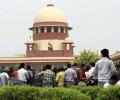
The Supreme Court has upheld a Madras High Court decision prohibiting animal sacrifice and granting limited prayer rights to Muslim devotees on the Thiruparankundram hills in Tamil Nadu.
